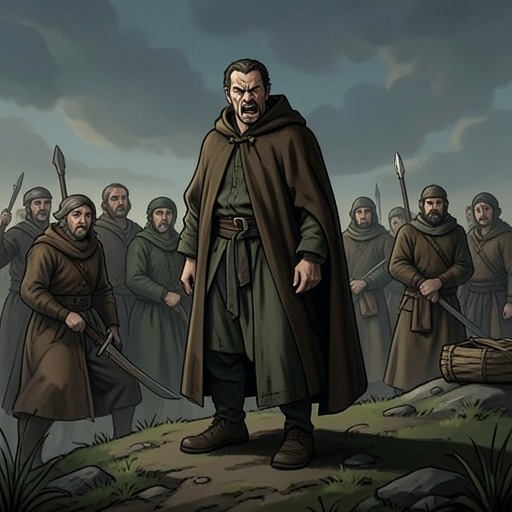
Maegor’s seizure of the Iron Throne
Fire & BloodMaegor’s seizure of the Iron Throne began at Dragonstone in the hours after King Aenys’s funeral. Rather than follow the succession law that favored Aenys’s son, Maegor claimed the crown for himself, relying on his ability to take and hold power. His self-coronation and the execution of the only official who dared object made the seizure a direct challenge to both inheritance law and the authority of the king’s council.
Background and Return
King Aenys was cremated in the yard at Dragonstone. His sons Viserys and Jaehaerys and daughter Alysanne attended; Queen Alyssa sang a dirge, and Quicksilver, Vermithor, and Silverwing all contributed fire to the pyre. The funeral marked the end of Aenys’s reign, but not a settled transfer of power.
Visenya Targaryen was absent from the funeral. Within an hour of Aenys’s death, she flew east across the narrow sea on Vhagar. When she returned, Maegor came with her, riding Balerion. His arrival turned the question of succession into an immediate contest over who could claim the throne and command the loyalty of those present.
The Claim at Dragonstone
Maegor stayed on Dragonstone only long enough to claim the crown. He chose not the ornate gold crown Aenys had worn, decorated with images of the Seven, but the iron crown of their father, set with blood-red rubies. Visenya placed it on his head. The gathered lords and knights knelt as Maegor proclaimed himself king, adopting the formal titles of king of the Andals, the Rhoynar, and the First Men, lord of the Seven Kingdoms, and Protector of the Realm.
The choice of crown made the act a pointed assertion of authority: Maegor claimed the symbols associated with his father rather than continuing the royal presentation favored by Aenys. Yet the ceremony could not by itself resolve the legal dispute. Its force depended on the assembled nobles’ submission and Maegor’s ability to make his claim effective.
Succession Law and Opposition
Grand Maester Gawen alone objected. He argued that the laws of inheritance, which the Conqueror himself had affirmed after the Conquest, required the Iron Throne to pass to Aenys’s son Aegon. Maegor rejected that claim and asserted that the throne would belong to whoever had the strength to seize it. He then ordered Gawen’s immediate execution and carried it out with Blackfyre.
The confrontation set the stated principle of lawful succession against Maegor’s openly coercive claim. Gawen’s objection invoked rules established under the Conqueror; Maegor answered not with a competing interpretation of those rules but with force. By eliminating the sole dissenter, he silenced the challenge in the room without establishing that the succession law had changed.
Immediate Aftermath and Significance
Queen Alyssa and her children were not present for Maegor’s coronation. Within hours of Aenys’s funeral, Alyssa had taken them from Dragonstone to her father’s nearby castle on Driftmark. Maegor responded to their absence by retiring to the Chamber of the Painted Table with a maester and dictating letters to lords throughout the realm. A hundred ravens carried those messages before the day was out.
The following day, Maegor rode Balerion across Blackwater Bay to King’s Landing, accompanied by Visenya on Vhagar. The dragons’ return prompted riots; people trying to flee found the city gates closed and barred. The Warrior’s Sons held the walls and fortified sites across the city, while the Targaryens raised their standards on Visenya’s Hill and summoned supporters. Maegor’s seizure therefore continued beyond the coronation: his claim had to be asserted across the realm and against organized opposition. The scene presents a stark contrast with royal ceremonies that depended on broader recognition, from Aegon the Conqueror’s coronation in Oldtown to the later coronations of Aegon II and Rhaenyra. Maegor’s first act as king instead made the conflict between inherited legitimacy and power seized by force impossible to ignore.